
WARNING: Thousands Of People A Month Buy $15 To $35 Night Splints On Amazon. Most End Up On The Floor By 2 AM.


I'm not here to sell you anything. I'm here because I wasted a year and close to $70 on night splints from Amazon, my heel had me limping through every shift, and at 1 AM one night, going down a Reddit rabbit hole, I finally figured out why none of them stayed on. If this saves even one person the same headache, it's worth writing up.
See The Night Splint That Stays On →I've worked in a warehouse for 14 years. Ten-hour shifts on concrete, up and down the aisles. My feet have taken a beating for most of that. You work hard, your feet hurt. That's the job.
About two years ago the heel pain got bad. Not tired-at-the-end-of-the-day bad. Sharp, stabbing, first-step-out-of-bed bad. I had to hold the wall just to get to the bathroom every morning, and I'd walk the first hour of my shift on the outside of my foot so the guys wouldn't notice.

I looked it up. Plantar fasciitis. Left foot. Turns out it's common in people who stand all day.
I did the stretches. Bought the $160 work boots. Bought the gel insoles. None of it touched the mornings.
Then a guy on my shift told me the problem is your foot points down all night. A night splint holds it up while you sleep.
He was right about that part.
So I went on Amazon, searched "night splint," and bought the one with the most reviews. $17. Soft, padded. I figured soft meant I'd be able to sleep in it.
Felt fine when I strapped it on at 10 PM. At 2 AM I woke up, ripped it off and threw it on the floor.
Over the next year I bought three more. Different logos, same splint, same result. Every one of them was off my foot before the alarm.

I started to think it was me. Maybe I was just a guy who couldn't sleep in one. My podiatrist's next idea was $600 custom orthotics.
"I started to think it was me. Turns out night splints were never the problem. I just kept buying the same $17 splint under a different logo."See The Night Splint That Stays On →
What I Found At 1 AM After A Double Shift
So I'm lying in bed, heel throbbing, going down a Reddit rabbit hole. I end up in a plantar fasciitis thread full of people describing the exact same night I kept having. Strap it on, wake up at 2, rip it off, feel guilty about it in the morning.
Then somebody who'd been through five of them posted a breakdown of why most cheap night splints never make it to morning. Not because the idea is wrong. Because of how they're built.
He started with why mornings hurt in the first place. When you sleep, your foot relaxes and points down. For hours, the tissue along the bottom of your foot sits in a shortened position. Then you stand up, and that first step pulls it tight all at once. That's the stabbing feeling in your heel.
Stretches, ice and insoles all work on it after it already hurts. A night splint is the only thing aimed at the night itself. It holds your foot up so that tissue isn't sitting short for eight hours.
But it only does that if it's still on your foot.
I read that thread three times. Then I looked at the splints in my drawer, and it all clicked.
Why Cheap Night Splints Don't Make It To Morning
The words on those listings mean nothing. "Upgraded." "Memory foam." "Soft & comfortable." There's no standard behind any of them. A lot of them throw in a free massage ball so a $17 splint looks like a kit.
Here's what I was actually buying every time:
🚩 Complicated straps. You need a video just to get it on.Three or four velcro straps, a bar you have to bend to fit your foot, and a card with a few blurry photos for instructions. I ended up on YouTube working out which strap went where. And when it comes off in the middle of the night, good luck strapping it back on in the dark.
🚩 A stiff bar that digs into the top of your foot.Most of these hold the angle with a metal or plastic bar that runs over the top of your foot. Tighten the straps and it presses straight into the bone. Plenty of people take it off within minutes. I lasted longer, but that's usually what woke me up at 2 AM.
🚩 Too tight or too loose. Never in between.Velcro is all or nothing. Pull it snug enough to hold your foot up and your toes go numb. Loosen it enough to sleep and your foot drops right back down. And you can never find the same setting twice.
🚩 It slides down while you sleep.Your leg gets narrower toward the ankle, so the straps creep down every time you move. A couple of hours in, the angle you set is gone and your foot is pointing down again. The one thing it was supposed to stop.
🚩 Velcro that snags your sheets and stops sticking after a few weeks.It grabs everything: the sheets, your pajamas, the other strap. Every snag packs more lint into the hooks, and a few weeks in it barely holds.
💡 The Honest Version
What most of us have been buying is a $17 splint built to look good in a listing photo. The idea behind it is right. Holding your foot up overnight is exactly what you want. But a strap and some velcro can't hold it there for eight hours, so it never gets the chance to work.
The guy who posted it summed it up, and it stuck with me: a night splint only works if you can sleep in it.

What I Actually Needed (And Didn't Know To Look For)
After that thread I spent another hour reading about what makes a night splint something you can actually sleep in. Short version, because nobody came here for a lecture:
Easy to put on. No video needed.If you can't put it on right with the lights off, you won't. It should go on the same way every night.
Soft against your foot. Nothing hard digging in.The part that holds the stretch can be firm. The part touching your skin can't be. No bar across the top of your foot, no hard plastic edges.
A dial, not guesswork.The people in that thread who stuck with a splint all said the same thing: start loose and work up. Velcro doesn't do small steps. A dial does, one click at a time.
Stays put all night.Whatever you set at 10 PM has to still be there at 6 AM. Velcro stretches and slips. A dial holds where you left it.
No velcro doing the holding.Velcro snags, fills with lint and stops gripping within weeks. The part holding your foot up shouldn't depend on it.
⚠ The Part That Gets Me
We'll spend $160 on work boots and $45 on insoles for the day. Then we cheap out on the one thing that's supposed to work while we sleep. The boots get you through the shift. The splint decides how the next morning starts.
How I Found Cerevie (And Why I'm Writing This)
Same thread. A couple of guys said the only ones that stayed on all night used a dial instead of velcro. That's how I found Cerevie.
I was skeptical. I'd heard "this one's different" four times already. But there was a 30-day money-back guarantee, and it was two for $69.99, about what I'd already burned on velcro. I ordered a pair.
I started it loose. Two clicks. Fell asleep.
Woke up at 6 and it was still on.
I want to be straight with you. There was no miracle. But after a year of waking up to a splint on the floor, that alone was worth it.
It was exactly what that thread described. Easy to put on. Nothing digging in. Held right where I set it.
I added a click every couple of nights. By day four I walked to the bathroom without touching the wall.
By the end of the first week I stopped thinking about my feet at work. For a guy who'd been limping for two years, that was a big deal.
"By day four I walked to the bathroom without touching the wall."
Cerevie™ TrueDial Foot Recovery for Sleep
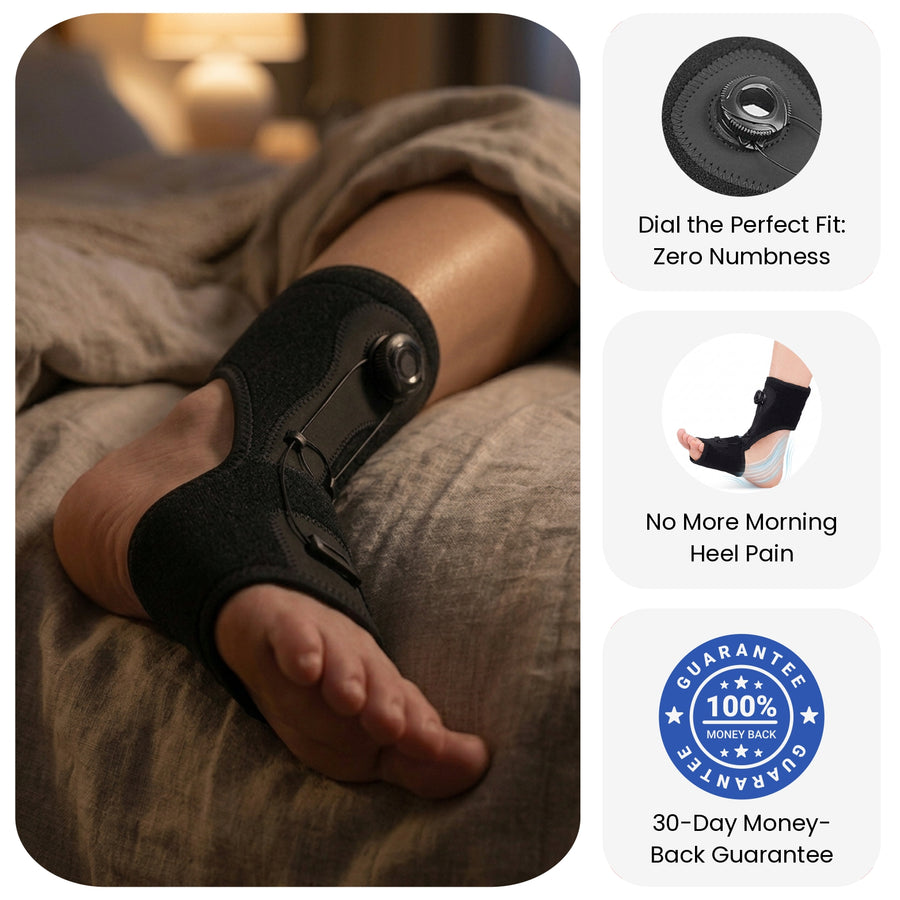
- Dial tension, one click at a time
- Holds its setting all night
- Holds your foot in a gentle stretch while you sleep
- Firm where it holds, soft where it touches
- Soft-brushed, latex-free liner
- Made for side sleepers, no hard plastic edges
- One size fits all, set with the dial
- Nothing to take, nothing to wear in your shoes
If you're reading this with a heel that stings every morning, a night splint in a drawer, and a little guilt about taking it off, this is for you. Doesn't matter if you're on a warehouse floor, a hospital floor, a shop floor or behind a register. If you've been buying cheap splints and wondering why none of them stay on, it's not you.
It's the clunky velcro design.
Take five minutes and look at what you're actually getting before you order another one. And stop buying those cheap Amazon velcro splints that don't work.
P.S. On the current sale, Cerevie comes as a pair. If both heels hurt, or it's starting in the other foot, that's one for each. If it's just one foot, keep the spare by the bed for when the first one's in the wash.


